Saturday, 28 April 2012

Denglish - Destroying our planet

Many regular visitors to this website will be familiar with my profound hatred of hybrid interlanguages, that is the result of one language unnecessarily using modern vocabulary from another, where appropriate terms already exist.

For me, this primarily concerns English terms used in French, German, Spanish and Dutch, but it is most prevalent in German, and has created a horrible phenomenon called Denglish.

Throughout history, languages have borrowed words from other languages to enrich their vocabulary. English itself is not as "pure" as say French or German, which have a clear, direct Latin and Germanic heritage respectively. Whilst English is considered a Germanic language, it is in fact a diverse mix of several languages.

A survey of 80,000 words from the Shorter Oxford Dictionary revealed that only a quarter of English words are actually "native", inherited from Old English, which in turn was influenced by Old Norse when the Vikings invaded. Another quarter comes from French, and another quarter from Latin. Five percent comes from Greek and the rest come from other or unknown sources.

Words borrowed from other languages are absolutely fine, if there is no existing alternative. When chocolate was introduced to this country from the New World, they had no name for it in English, so the sensible thing to do would be to use an anglicised version of the word where this strange, exotic delight came from.

Germans do this to some extent. Whereas we "unfriend" someone on Facebook, they entfreunden. This is a literal germanicised version of the word that has been adapted to German grammar rules, with ent- being a negative prefix, like "un-" or "de-" in English, freund meaning friend, and the suffix -en indicating a verb.

But when Germans want to chillen, surfen the Internet, go to eine Afterparty or talk about "ein Shitstorm", this gets ridiculous and redundant. There is so much English used in German today that they feel the need to have an Anglicism of the Year competition, which this year was won by "leaken" - to leak.

Personally, I think this is happening more so in German than other languages due to the lack of national identity following the war and the influence of the presence of the British and American military in Germany afterwards. But the Germans have re-discovered their identity, following the reunification of the country in 1990 and events such as the Football World Cup in 2006, which have proved it's okay to be German, to wave the German flag and to speak the German language.

Whilst the German youth may think its cool to use English words and phrases like these, older Germans are not so happy about this bastardisation. The Gesellschaft für deutsche Sprache (Society for the German Language) and the Verein Deutsche Sprache (German Language Association) were set up preserve the language, and they believe there seems to be this attitude that English is somehow 'better' than German, and that German somehow sounds old-fashioned, particularly for a certain group of people.

The easy thing to do would be to blame English and English speakers, but this would wrong. Whilst the use of English is growing internationally, it is native speakers of other languages who choose to learn it and then adopt its vocabulary into their own languages. We Brits who do speak foreign languages, on the other hand, would rather speak them in their purest form and we prefer for our language not to be abused in such a way.

Now, you may ask, "Language Man, why do you hate Denglish so much?" Well, the problem with introducing English terms into other languages, for which there is actually an existing term already, is that the meaning may become blurred and get lost in translation. Just look at "ein Handy", a mobile phone, and "ein Beamer" a video projector.

More complicated examples can cause hell for us translators, because although we may see an English-looking word in a text, it often looks out of context due to the change in meaning and we may not fully understand what is actually meant. If I'm wearing a "Smoking" in German, it's unlikely that most will know I'm actually wearing a dinner jacket, and what is a "Streetworker" in German? Someone who collects money for charity on the street or someone who helps homeless people? Or perhaps a 'lady of the night'? No, it's actually a social worker.

Besides excluding older Germans from their own language, Denglish diminishes cultural boundaries and increases the likelihood of all of Planet Earth's cultures and languages merging into one, which perpetuates the stereotype held mainly by Americans that Europe is one country and everyone speaks English there.

So, Denglish ranks number one on Language Man's list of things that are going to metaphorically destroy our planet. In preparation for the end, I shall put on my Abendanzug rather than my Smoking.

Wednesday, 25 April 2012

Des aventures toulousaines - Part 3: Des aventures polonaises

A mere three or four weeks into the job at Saint Exupéry, I was informed that I was going to Poland. I didn’t know quite how to react to this at first because it came very abruptly and I had never imagined going to Poland. I’ve got nothing against Poland or the Poles, but as much as I love travelling, I feel out of my depth when going to countries whose language I don’t speak, and I didn’t really know much about the country or its people. Nevertheless, a unique opportunity arose and I would have been foolish to turn it down.

The reason behind the Poland voyage was an E.U. cultural exchange programme. One class from the Terminale year group (the final year of school) had struck up a partnership with counterparts at a school in a town called Stalowa Wola, in south-east Poland, and in November 2009, the time had come for a 10-day visit to see the Poles. This programme had been going on for a few years so luckily the two French teachers who went on the trip, Rémi and Fabrice, had been there before and knew what was going on, rather than the E.U. just firing us in a tin can at 500 mph towards Poland and then leaving us to sort ourselves out.

I had only known my class and the teachers a month or so beforehand, so I was a bit anxious about going. I didn’t know where I would fit in; although I was closer in age to the students, who were all 17-18, I was still technically a teacher, and that’s how I thought they saw me. The class had got on quite well with Rémi, or rather Mr Weissberg, as he was still (relatively) young. He went to uni in Brighton and to me he sounded like a native English speaker. Really, it could have been just like a lads trip to Poland...with some kids tagging along.
Our prestigious Welcome Ceremony

So, Toulouse airport, at ridiculous o’clock, waiting for the flight to Warsaw via Frankfurt in my Toulouse rugby t-shirt, this was the start of a very long journey to Stalowa Wola: two two-hour Lufthansa flights, then a six coach journey. Great. Luckily, I had brought some reading material: a Polish-French phrase book, and in my capacity as a language teacher, I took it upon myself to educate the kids with some Polish phrases, principally one that translated as “elle est belle comme un petit phoque” or “she’s as pretty as a seal”. This must say a lot about Polish girls.

After a long coach journey through Warsaw (consisting of tall concrete slabs) and the Polish countryside, which we didn’t see much of as it was dark for much of the journey, we arrived fairly late thanks to the lack of motorways in Poland. The kids were promptly paired up with their counterparts after the awkward silence of meeting for the first time, similar to your first boy-girl disco, and they drove off home for the night. Us three teachers were then assigned a Polish teacher to stay with. Fortunately, I wasn’t completely alone with a stranger in a country I had been in for a few hours, as the teacher had a daughter who one of our students was paired up with.
Breaking the ice

The Polish teacher I stayed with was lovely, and had a really nice, comfortable house, with lots of wood panelling so it felt like a cosy forest cabin. She cooked a mixture of Polish and international food for us each night, and laid on a more than satisfying breakfast each morning. She later explained that the Polish prided themselves on hospitality, and it would have been rude not to take advantage of this. I offered to help with the washing up but it turns out that this can be insulting from a guest to a host. Fair enough.
Bonding session
The next day was spent at the local high school. There was a rather prestigious welcome ceremony in the gymnasium in front of the whole school, with personal introductions for us teachers, followed by the French and Polish national anthems (not the Welsh or British one though), and then a sort of play, with Polish students acting out various French and Polish historical figures (no Welsh or British ones).

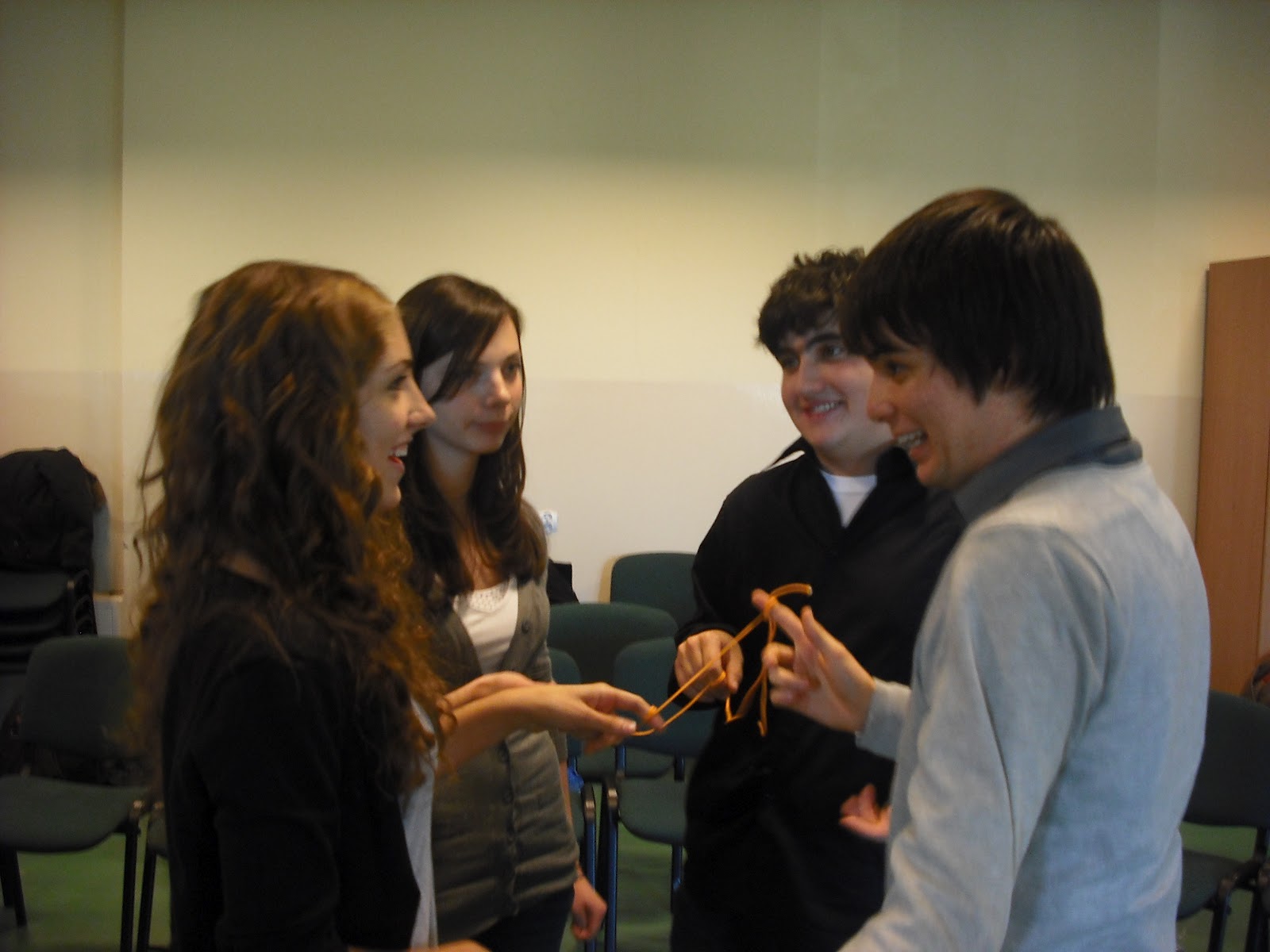
There were some educational parts to this programme too, so the school had organised loads of activities for the kids. The first one was a sort of ice-breaker session. I can’t remember the particularities too well, but it seemed to involve tying an elastic band to everyone’s finger...and passing stones to each other on spoons...

Part 2: Une Ville des Arts 

Part 4: Des Petits Phoques 

Monday, 23 April 2012

How to get more people to take the stairs

Taking the metro to work each day can be quite monotonous. But here's an ingenious idea to make it fun to take the stairs instead of the escalator at Odenplat station in Stockholm, Sweden.

Saturday, 21 April 2012

Who vs. whom

"Learning a foreign language helps open your eyes to how your own language works." This is one of those marketing hooks that we hear all the time from language teachers to encourage people to branch out linguistically - but it is actually true. If I hadn't studied other languages, I wouldn't get so wound up about grammar mistakes in English.

Who vs. whom is a classic debate. When should we use 'whom', or should we even use it at all? Well, here's the answer:

When should we use 'whom'?
Firstly, in the highest possible degree of layman terms, we use 'who' when talking about the person doing something, and 'whom' about the person having something done to them. Sorry if that sounds dirty, but here are some examples:

"Who saw you? It was the girl who saw me." The girl is the one doing the seeing, therefore we use 'who'.
"Whom did you see? It was the girl whom I saw."  I saw the girl, so it is the girl being seen rather than doing the seeing. So, we use 'whom'.

Secondly, we use 'whom' with a preposition (words like 'to', 'from', 'with', 'of', 'on', 'under', etc.). So: "the boy whom you wrote the letter to", although that opens up another can of worms on whether we can end a sentence with a preposition (but we'll save that for another week).

If this is still confusing, there's a handy rule to help. You can substitute 'he' or 'she' for 'who', and you can use 'him' or 'her' for 'whom', i.e.:
  • Who went to school with you? He went to school with you.
  • Whom did you go to school with? - You went to school with him.
Do we actually need to use 'whom'?
Using 'whom' sounds old fashioned to most, and many don't use it at all, so do we still need it? Yes and no. No, because we don't really need it in grammatical terms. We still understand the whole meaning of the sentence without it. Besides, language changes all the time; we don't use 'thou' or 'thee' anymore, so why should we hang on to 'whom'?

It's all about style - it is still used to indicate what kind of register of language we want to use: we often use 'whom' if we are using high-register, formal, written English - probably because it is seen as old-fashioned. Read The Independent or The Times and you will still see 'whom' widely used. Equally, we avoid using 'whom' in informal, conversational English. We hardly use it when speaking and sometimes we don't use it when we're writing, just read The Sun for example.
Use 'whom' to talk like a sir
We can therefore deduce that 'whom' is not completely useless as we can use it to establish what kind of a relationship we have with the person we are speaking to (or rather with the person whom we are speaking to - but I do not wish to establish such formality with the readers of this blog).

So no, we don't need to use 'whom', but you can use it to sound elevated and to talk like sir. 

So is that 1-0 to us commoners over the grammarians?
Well, if you want to put it that way. I don't feel that the militants have a case when they try to force others to use 'whom' for the sake of it when its grammatical function is redundant.I could make a very long list of grammatical structures that we have stopped using over the past century. That's a natural process in language, something which some users of Twitter need to understand - the ones who kick off about Twitter's suggestions of "Who to follow".

English is a particularly dynamic language. We lack complicated, unnecessary elements of grammar that our neighbouring languages have retained. We don't have adjective endings like you see in other Germanic and Romance languages. Nor do our nouns change depending on their grammatical role in the sentence, like they do in Slavic languages. What English learners love most about the language is that we have minimal conjugation, that is changing verbs to fit the person (whom) we are talking about and which tense we use. Just look at French:

I work............................Je travaille
You work. (singular)............Tu travailles
He works.........................Il travaille
We work..........................Nous travaillons
You work (plural)................Vous travaillez
They work........................Ils travaillent

Only one change here for English, but six varieties in French. Then six more each for each tense. English has had a metaphorical clean up of its bedroom and thrown out all the old junk that it doesn't need anymore, where French has just left its bedroom in a state, hoarding a load of old junk it doesn't need.

Does that mean I don't have to stick to grammar rules in English.
No. Absolutely not. It's "should have" not "should of". 'Your' and 'you're' mean different things. And you don't use an apostrophe when making words plural - it's 1960s, not 1960's, and chips instead of chip's. That ends this post as Doctor Whom is on TV.

Wednesday, 18 April 2012

Des aventures toulousaines - Part 2: Une ville des arts

I went to the school beforehand to meet the teachers and some of the students. Blagnac was a leafy suburb with houses slightly bigger than other areas of the Toulouse and many had pools -an immense contrast in working in one the wealthiest areas of Toulouse with living in one of the poorest, although I did love where I was living - just a few metro stops to town, right by the river, right by the stadium, near the markets, and my landlady was fantastic. She came with me to help me set up a bank account, which can be intimidating if you’re not up to scratch on financial terminology in French. She also introduced me to her side of Toulouse - a city of art. Not just pretty paintings, but the broader sense of the word: engaging local people in cultural events and projects and allowing people to express themselves vocally, visually and so on. She showed me the range of initiatives she had been involved in to engage the residents of the high-rise, low-income, inner city district of Empalot. The one that impressed me the most involved installing massive black and white canvas pictures of local people at the top of the high-rise blocks of flats (see right).

Of course, I spent the weekends exploring the city. €10 a month for unlimited bus and metro access was a bargain, but also well worth purchasing was a year’s access to VélôToulouse, the extensive bike hire network in the city, for €25. No-one does these cycle-hire schemes like the French. Modern and comfortable 3-speed bikes in good condition could be hired from dozens of stations around the city, each spaced about 100 m apart, and thanks to Toulouse traffic, I often got off the bus early to cycle the rest of the way home. And with a smart card, it was so quick and easy to just pick up a bike, ride away and drop it off at any other station. After paying the subscription fee, the first 30 minutes of the ride were free every day and €1 per hour thereafter. The same kind of scheme has been installed in London and I hope it will catch on in the rest of our major cities.
One bizarre thing about Toulouse is the severe lack of taxis. I saw about three taxis in my entire year. With the metro and buses stopping at 1am, these bikes were my most frequent way of getting home after a night out. Luckily, I can handle my drink!

I had a week or so to settle in before I started work at Saint Exupéry. The school itself was very modern, only opening in 2004, and had 1500 students aged from 15 to 20. For the 15-18 years olds, it was their local high school, but for the 18-20 year olds, it was a specialist school, apparently only one of five schools in France to offer the chance to specialise in aviation mechanics, due to its proximity to the Airbus headquarters at Toulouse Airport. This was great for me as I wanted to be a pilot when I was younger, and I could adapt my lessons around aviation, which I did for the older students. But for the younger pupils, their lessons were based on whatever was in the news. Fortunately, 2009/10 was an eventful year so my students were introduced to the likes of Susan Boyle, Jedward and most excitingly, the new PM, David Cameron.
I did find it hard to plan lessons. I had next to zero teaching experience so I had to improvise a lot. Most of the time, I didn’t even have to actively teach. The best way to help the students improve their English was to just talk with them. It doesn’t matter what the subject is. The teachers were quite happy with this and so were the pupils, because they could talk about whatever they wanted, and they were secretly learning at the same time.

In all honestly, I don’t think I could have asked for a better school. It seems like everyone there wanted to learn English. They even put up with some of the more boring lessons. But I wasn’t a teacher after all. I was only 20 at the time, very close in age to most of the pupils, so I didn’t want to be seen as a teacher, just someone to casually practise English with, in a less formal and more relaxing setting. Something I saw more of on the school trip to Poland...

Part 1: La Ville Rose

Saturday, 14 April 2012

Obituary: Nicolas Sarkozy

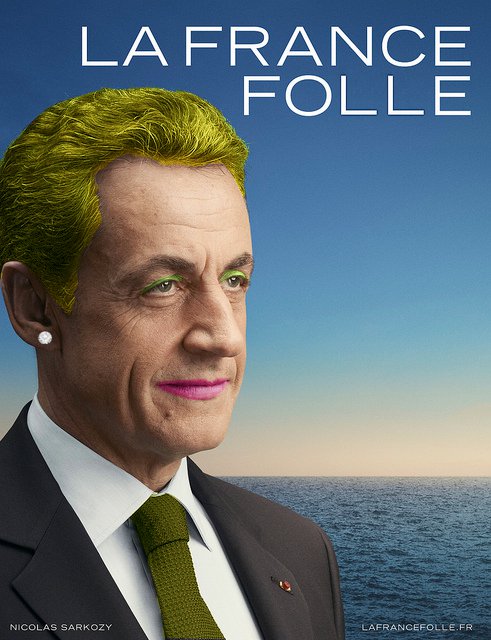
Sarkozy's presidential campaign poster
reads "A Strong France", subjected to
parody of course (see below)

I love a good election. It's just under a week to go until the French choose their president for the next 5 years. France has been run by a centre-right president since 1995, but seems to have had enough of Nicolas Sarkozy's increasingly right-wing policies and is ready for a change.

Sarkozy was elected narrowly - by 53% against 47% for the Socialists, but a month into his term, his party, the UMP, won a majority in the general election.  

Nevertheless, he has been progressively alienating more and more people further into his term. He got off to a bad start even before his presidency as the Foreign Minister by denouncing those involved in the 2005 French riots as "racaille", or "scum", which may well be true, given the British public's perception of those involved in similar riots in London last year, but it's not very wise for a senior politician to be so blunt when trying to win votes.
"A Mad France"
There have been numerous controversial laws that have been passed during his leadership - most infamously the so-called "burka ban". Seen as an attack on Muslims not conforming to his view of French society, it is now illegal to wear any item of clothing that covers the face, with notable exceptions such as a motorcycle helmet. Equally, he attempted to strip French citizenship from naturalised citizens convicted of a serious crime, which was later ruled as unconstitutional.  

He has also implemented typically conservative policies, such as reducing taxes for the wealthy, raising the retirement age and revoking inheritance tax, but he has spearheaded E.U. attempts to improve the economy and led the military intervention in Libya.

A man of vanity, Sarko was voted one of the best dressed men by Vanity Fair, and even had French magazine, Paris Match, digitally remove a love handle from a picture of him. No-one can accuse the 160 cm (5ft 5in) tall man of having Short Man Syndrome.

As with many democratic countries, it's usually a two-horse race: Labour vs. Conservatives in the UK or SPD vs CDU in Germany - and France is no exception. The centre-left Socialists' candidate, François Hollande, has been the favourite to win for some time, perhaps chosen by the anyone-but-Sarkozy voters rather than for his policies or his charisma, or lack thereof. 
"A Free France"
Hollande comes across as confident, experienced and determined, and is trying too hard to position himself as a liberal socialist by proposing a 75% tax rate for earners of more than €1 million, supporting gay marriage and adoption, pushing renewable energy and planning to recruit more civil servants.

It seems that the election has come at the right time, with a change of government more likely at times of economic problems, but we've seen it all before...promises, promises and more promises, possibly making this article redundant.

Whatever the outcome and despite his legendary gaffes, France will have had a more memorable leader over the past five years (albeit in the same way that Sivio Berlusconi was memorable) and it is worth remembering what he actually has accomplished since 2007: abolishing tax on hours worked over the 35-hour week, his work towards peace in the Middle East, and forging closer relations with one of France's closest allies and neighbours, the UK, damaged by the likes of the ungrateful De Gaulle and corrupt Chirac.

"A Dead France"
A Certain, Well-Off, Elitist, Cynical,
Racist, Disdainful and Warmongering
France


Wednesday, 11 April 2012

Des aventures toulousaines - Part 1: La ville rose

Never had my gut feeling been so wrong. I remember the night when the phrase “butterflies in my stomach” didn’t even come close to how I felt. It was 2 a.m. on a September morning in 2009. The car was packed and ready to go, and my parents and I were about to leave for a journey that would take us through the Channel Tunnel, across France, down to Toulouse. It was the fear of the unknown in what would actually become the greatest year of my life to date.

As part of my Year Abroad, I chose to work as a part-time English language assistant in a comprehensive school: Lycée Saint-Exupéry, in Blagnac just north of Toulouse – a city I had no prior knowledge of.

I spent the summer casually researching the city to see what I could expect: was it young or old? modern or old-fashioned? belle or moche? But it was a stressful time, as time was quickly running out to find somewhere to live, which involved ringing up people in France and speaking French. Terrifying. Luckily, I found a flatshare in a bright apartment that was really close to the city centre, overlooking the River Garonne, and more importantly, the city’s main stadium. And I got to live with French people! My lovely landlady, Isabelle, who introduced me to the arts scene in Toulouse, and Kévin, an 18-year-old lad in his last years of school, who I didn’t really see much of.

Breathtaking views in the Pyrenees
So, we set off on the epic drive, stopping overnight in Le Mans, arriving at a holiday home south of Toulouse where we would spend the week first, and I couldn’t have asked for a better start to the year. We spent the week touring the south-west of France, taking in small, picturesque towns such as Albi with its striking cathedral, tranquil Pau in the mountains and chic Biarritz on the coast. We ventured into the lush, green Pyrenees which were yet to be covered in snow, where I discovered a language that even I, Language Man, had never heard of, called Occitan – somewhat between French and Spanish – which I would later find out more about and base my university project on.
One of the many bridges in the
centre of Toulouse beautifully
lit up at night

The time came for my parents to abandon me and leave me to fend for myself. I spent a few days settling in and getting to know the city by hiring a bike and exploring the narrow streets, checking out the markets, seeing the sights, and also arranging to meet up with other English-speaking assistants in the city. I quickly got to know Place St Pierre – the hub of la vie nocturne in Toulouse – and made some Anglophone friends. Now I felt a little bit more relaxed and ready to start at school...

Part 2: Une Ville des Arts 

Tuesday, 3 April 2012

Why aren't Germans prouder of their music?

iPhones are great. You can download an app that allows you to listen to hundreds of German music stations using your 3G or WiFi connection. This is a great idea for getting into what I like to call "German mode" when doing university work for German, or doing German translations at work, like I do.

There is one flaw in this, however. I have yet to find one of these German radio stations playing music in German. I've heard Robbie Williams, Seal, Kelly Clarkson, Ed Sheeran, Cee Lo Green...you get the idea - only music in English.

Germans are naturally within their right to listen to music in English. After all, it's "cool" for the youth on the continent to speak in and listen to anything in English, but to the entire detriment of their own language?

As well as being one of the traditional heartlands of classical music and famous for its cabaret (more so in the Anglosphere thanks to Liza Minelli), Germany actually produces some excellent contemporary music, albeit influenced by British and American music.

Main genres to come out of Germany in the past few decades include:
  • Schlager, similar to 80s style pop ballads (don't deny it - you sing along to "Heaven is a Place on Earth" by Belinda Carlisle whenever it comes on the radio)
  • Neue Deutsche Welle [New German Wave], which derives from the British punk scene of the 70s and 80s
  • Hamburger Schule [Hamburg School], experimental underground pop music,
These days, the German music scene is dominated by simple pop-rock music (my favourite band is Wir Sind Helden), heavier rock and metal music (I think Rammstein are still going) and punk music is also still active (such as Die Ärtze [The Doctors]) and I think most are familiar with the ambassador to German techno and electronic music: Kraftwerk.

Naturally, this kind of stuff isn't played on the radio in the UK because it's all in foreign. We already speak the world's lingua franca so there's no need for us to broadcast the music of other cultures. Whilst I resent this and naturally encourage Brits to learn more languages, I don't anticipate music in the language of our neighbours becoming popular any time soon. In fact, musicians of such countries seem to have to release music in English in order to make it in the world of music. David Guetta, Enrique Iglesias, ABBA...the list goes on.

But what shouldn't happen is that music by artists from a non English-speaking country sung in English becomes so popular in said country that it becomes impossible for an artist releasing music in that country's native language to make it. Otherwise, we are slowly destroying multiculturalism, uniqueness, diversity and everything else that is great about Planet Earth.

Friday, 30 March 2012

Eurovision 2012 - Worst 5 - #1 Montenegro

With a population similar to that of Glasgow, Montenegro could have sent its version of Franz Ferdinand, Primal Scream or Travis, but it has instead elected to find the nearest homeless person on Podgorica's High Street, and offer to wash his vest top and wooley hat for free if he agrees to represent them in the Eurovision Song Contest.

What they didn't offer him, however, were shaving facilities. Luckily, said homeless person speaks English. But I still don't think he would have got much money busking with this song. Or is it a rap? I'm not sure. In any case...le Monténégro, nul points.

Eurovision 2012 - Worst 5 - #2 Georgia

There seems to be a trend this year with countries who have sent good entries in previous years sending poorly thought-through comedy songs...and Georgia is one of them.

Its title "I'm a Joker" is quite fitting, because this song is simply a joke, no matter how many fireworks or how much 70s style disco lighting you use to distract people from this Joker.

Wednesday, 28 March 2012

Eurovision 2012 - Worst 5 - #3 Russia

Russia has gone for a song with a more traditional dance this year, albeit to up-beat disco music, and having it performed by six 80-year-olds may seem cute to them, but this was not to my taste at all. 

There's always one completely ridiculous song that does well and this will be it.

Tuesday, 27 March 2012

Eurovision 2012 - Worst 5 - #4 Austria

Austria has long been known for sending atrociously bad entries leaning towards comedy acts rather than musical ones. This year is certainly no exception. It features two young gentlemen, who seem to have tumbled out of Topshop's smart department - which means a suit, but unironed, untucked and with an ironic tie - shouting into a microphone and punching the air angrily.

There is one aspect that I do like, and that is the fact that the song, "Woki mit deim Popo", is sung in a dialect of Austrian German called Mühlviertelerisch, which equates to the UK sending an act singing in Westcountry. Regardless, no Eurovision song should translate as "Shake your ass".

Monday, 26 March 2012

Eurovision 2012 - Worst 5 - #5 San Marino

San Marino, a country enclosed by Italy with a population of 30,000, can be forgiven for not having a large pool of talent. But, there was still no need to send a song about social networking by a singer that requires autotune. The melody sounds cheap and as if it has been taken from the public domain, the lyrics are few and far between, most of which consist of "uh oh oh oh ah", and twenty seconds into the song, you just sigh and think what's the point?


Saturday, 24 March 2012

Why is it so hard to get the name of a country right?

A new TV reality singing show starts tonight called The Voice. Now, I thought this competition sounded familiar, and it was because I had heard of the original show, The Voice of Holland. But wait...don't they mean The Voice of the Netherlands?

Well yes, that should be correct, but it seems that the Dutch, in their acceptance of everything that is English (see blog post below titled Dutch: The Lost Culture), have widely adopted an erroneous name for their own country, with even the website of their national tourism agency being holland.com.

Holland is merely one region of the Netherlands, consisting of two of the country's twelve provinces, so to refer to the whole country as Holland equates to referring to the UK as England (which some do). This can be hugely offensive to people in the other three constituent countries: Wales, Scotland and Northern Ireland. So, why the Dutch aren't offended by this is something I can't understand.

It is understandable as to how this error arose. Holland contains most of the Netherlands' major cities - Amsterdam, Rotterdam, The Hague and Leiden. Equally, England contains 21 out of 25 of the UK's largest cities - the exceptions being Edinburgh, Glasgow, Cardiff and Belfast.

Nevertheless, it is puzzling as to why the Dutch are effectively patronising their own country, and whereas the UK is keen to deter others from referring to it as England, the Dutch seem to be paradoxically encouraging people to call it Holland.

Links

Links have now been updated. Language Man only approves the most worthy of websites and blogs, so check them out:

And remember, next week sees a series of posts on the Top 5 Worst entries of this year's Eurovision!

Friday, 23 March 2012

Eurovision 2012 - Top 5 - #1 France

Not many songs fulfilled all the criteria for the song I'd choose as my favourite:
  • Up-beat dance song with predictable lyrics
  • Sung mostly in the country's native language (and one that I can understand)
  • Not an atrocious singing voice
  • A sufficient amount of colourful flashing lights to keep me entertained 
In fact, this was the only one that met all four points. At first, it sounded like a horrible RnB song, but quickly transformed itself into a celestial-like sound reminding us why we love Eurovision. This is the kind of song that will either do quite well, or very badly.

It certainly won't win, but I'm glad that France have prevented this year's competition from turning into a dismal display.   

Eurovision 2012 - Top 5 - #2 Denmark

Denmark have chosen a cross between Sergeant Pepper and a submarine captain, unsurprisingly singing a soft rock song. There's someone with an acoustic guitar in their act every year. It won them the 2000 contest, but it's ballads that do the trick these days.

It's not too far-fetched to imagine this song in the Top 10 of the UK chart, outside of the Eurovision context, as it's beautifully sung, regardless of how ridiculous she looks. 

Wednesday, 21 March 2012

Eurovision 2012 - Top 5 - #3 Ukraine


Everything I like about this song, I also hate: the mesmerising lighting, the fast-moving purple trumpeteers and the ambiguity as to whether the singer is male.

What's more, I can't decide if this woman can sing or not, but she does have a pair of lungs on her. But, this ensemble does make for a more entertaining three minutes than most of he line-up.


Eurovision 2012 - Top 5 - #4 Netherlands


A refreshing alternative with this Native American-themed song. The Netherlands often don't make it past the semi-final because they usually send out-of-tune badly written pop entries sung in Dutch English.

This singer's pronunciation isn't perfect - you can hear Dutch diphthong sounds quite clearly - and this is always a danger when non-English speaking countries sing in English. But as one the few songs that isn't a repetitive pop song or a boring ballad, this song is very listenable.

Monday, 19 March 2012

Eurovision 2012 - Top 5 - #5 Greece


Greece has done consistently well in recent years, including coming 3rd in 2001, 2004 and 2008, and winning the competition in 2005, all by choosing songs that are...well, Greek.

A high-powered dance routine to a rapid pop tempo dominated by that Greek guitar sound with a handful of young men who look like waiters dancing around a scarcely-dressed female in a sparkly dress always does the trick. This year is no different, albeit slightly more bland. Nevertheless, it should guarantee the usual maximum points from Cyprus and Albania, and minimal points from Turkey and Macedonia.

Sunday, 18 March 2012

Eurovision 2012: Top 5 and Worst 5

Eurovision Song Contest 2012.svg9 weeks to go until my favourite time of year...Eurovision 2012. And to celebrate the release of all the entries, I will be posting the Top 5 and the Worst 5 over the next two weeks starting on Monday 19th March.

There seem to be a disproportionately high number of ballads and a lack of cheesy pop numbers, much to my dissatisfaction. But there is no shortage of weirdness as usual, including a song about Facebook, and Jedward are back.

To subscribe to Language Man, click "Follow" at the top left of the page.

Saturday, 17 March 2012

Language Man Relaunch


Welcome to the relaunch of the Language Man website.

The website has switched to a new host to allow for better blogging features. I have moved over most of the content and some of last year's featured blog posts.

Blog posts to come will be focusing on: 
  • Portmanteaus, The rise of - What the kids are coming up with these days (one of my favourites being bromance)
  • Denglisch  - Is "der Shitstorm" really necessary as a German word?
  • Toulouse - La Ville Rose - A reminiscent tale of one of Europe's most beautiful cities
And with just over two months until EUROVISION 2012, you can expect many posts on that.

Wednesday, 2 November 2011

Dutch: The lost culture

Learning another language also enables one to dispel any stereotypes previously held. The French do not wear stripy tops, wear berets and carry baguettes around all day long. Equally, the Germans are not all blonde, tubby, moustached Bratwurst-munchers. The Dutch, however, do all speak English. And it’s annoying.

Interestingly, English films and television programmes (40-60% of Dutch TV) are not dubbed, just subtitled, which allows the Dutch to hear, understand and match the English to Dutch. English is taught from primary school, bilingually in some secondary schools and as the exclusive language on many university degree programmes. Contemporary Dutch scientists hardly write in Dutch since there is no incentive to do so. English is beloved by the Dutch so much that they have adopted the often widely-used, albeit incorrect term “Holland” to refer to their country, which by all logic should actually infuriate them.

So it comes as no surprise to learn that 86% of Dutch people speak English according to an EU study. But why? To say that no-one speaks Dutch as a second language is a bit of an overstatement, but it could well be due to the Netherlands’ relatively small size and high trade with the neighbouring UK. It could also be the influence from the incessant stag parties making the pilgrimage to Amsterdam.
Of course, I’m not going to argue that the Dutch shouldn’t learn English. Nor am I going to deny that English is the international lingua franca, which is something I’m not happy about as I don’t believe there should be one lingua franca. Indeed, English is the new Latin in the scientific world and the new Italian in the literature world. It has seeped into the most remote pockets of the world triggered by the British colonialism of the nineteenth century. But this has planted English seeds in different countries, allowing non-native English versions to germinate. One of them is Dutch English – similar to Euro English (with phrases such as “let’s give a party” and “let’s take drinks at the pub”). English now serves as a vocabulary database for the Dutch to pick from as they please.

Conversely, English did the same thing with its neighbouring languages (principally French, German and Dutch) as it developed into its modern form. In fact, the “Netherlands” comes from the Dutch word for their country which literally means “low country”. Nevertheless, as words and structures from English mix with those from Dutch, they create a sort of hybrid language, which is then passed on through mutual discourse. It gives rise to phrases and structures that we would consider incorrect in English, thus giving a false impression of our language that is stubbornly believed to be correct by English learners.
What occur as a result are clumsy hybrid phrases such as ‘How do you underbuild that?’ or ‘Which answer is not good?' What’s more, it is this variety of English that can be heard at institutions across the Netherlands, and the Dutch aren’t doing anything about it. But who needs native speakers from just across the North Sea to teach in English when the Dutch are fluent enough anyway?
I had the misfortune to visit Amsterdam in January. I was actually looking forward to it until I arrived and was not permitted by the locals to speak Dutch. No wonder that the rest of the Netherlands say Amsterdam isn’t really Dutch if I get replies in English to questions I asked in Dutch. 

The English aren’t entirely blameless here. It’s the stag parties in Amsterdam that are forcing their language, their customs and their manners upon the locals, whilst simultaneously providing a false impression of the British, and to be able to cash in on the tourism, is there really much choice for the Dutch other than to sit back reluctantly and watch it happen? Well, yes. Stag parties can easily go to Newcastle. I’m sure there's something else other than the slightly more relaxed laws or tolerant policemen that make Amsterdam so attractive. There is still some element of real Dutch culture that is so appealing.  

The point is that the Dutch are allowing English to threaten their culture that has been built up over hundreds of years. Their clever language, their traditional music, their rich cuisine are all at risk of fading away, when such things should be embraced and encouraged instead. By all means, learn a foreign language, and open yourself to more opportunities in this increasingly smaller world, but don’t forget who you are.

Tuesday, 17 May 2011

Eurovision 2011 report

The Eurovision Song Contest 2011 held in Düsseldorf pulled in 12.7 million UK viewers on Saturday - that's a third more than last year. It could be that this year we fielded an entry who had actually previously released a song, let alone three albums, rather than Joe Bloggs, 48, from Barnsley. I would rather put it down to the fact that it was the second time in a row that Western Europe had snatched the contest back for about a decade, following a long stretch of Eastern bloc-voting...you know, the old "sorry we went to war with your country, here's twelve points to say sorry." 

The national jury element of voting was reintroduced in 2009 in an attempt to break bloc voting and make the contest fairer by having a panel of politically unbiased professionals judge the quality of the song, rather than the nationality of its singers. By combining the jury vote with a public televote, each comprising 50% of the total vote, abracadabra, Norway won, followed by Germany the next year. Hallelujah, Europe is in equilibrium once again. Oh wait, no it isn't.

The split voting table reveals that public votes alone mean that Norway still would have won by miles. However, with a pure jury vote, the UK's 2009 entry came third (that time Andrew Lloyd Webber got involved), rather than tenth which is how the European public deemed us. Eventually, we came fifth after combining the two votes, a great improvement after sending Jemini (Royaume-Uni: nil points) and Scooch (Royaume Uni: mais c'est quoi ça?? qu'est-ce qui se passe!)

It was Azerbaijan who took the crown this year with a fairly reasonable, albeit soppy, love song (see right). This will be the first time the contest won't be held in Europe. The 2004 contest in Turkey got away with it by holding it on the European side of Istanbul. It will also be the first time the contest will be held in a country with several active military conflicts, reports Cafe Babel, as Azerbaijan is home to several disputed territories and ongoing military conflicts in Chechnya, South Ossetia and Dagestan. Next year will be interesting then.

The reason I was just moaning about bloc voting and how it has apparently been resolved is that the vast majority of Azerbaijan’s points came from eastern European countries. The only Western European country to give Azerbaijan 12 points was Malta, and if you saw their entry this year, you would question their legitimacy in judging musical talent.

Eastern bloc countries now make up more than half of the participants and this has resulted in a shift of weighting towards the east. Russia's win in 2008 prompted long time Eurovision commentator, Terry Wogan, to quit after the country received huge numbers of votes from former USSR states and virtually none from western Europe.

After a two year absence, bloc voting is back, but let's also take into account that the 2011 top ten was equally composed of Western and European countries. Italy, Sweden, Denmark, Ireland and Germany came second, third, fifth, eighth and tenth respectively. So was it really worth re-introducing a national jury, or should we just ban Eastern Europe from entering the contest, because it couldn't possibly be due to any other factor such as sharing a similar cultural background or taste in music.